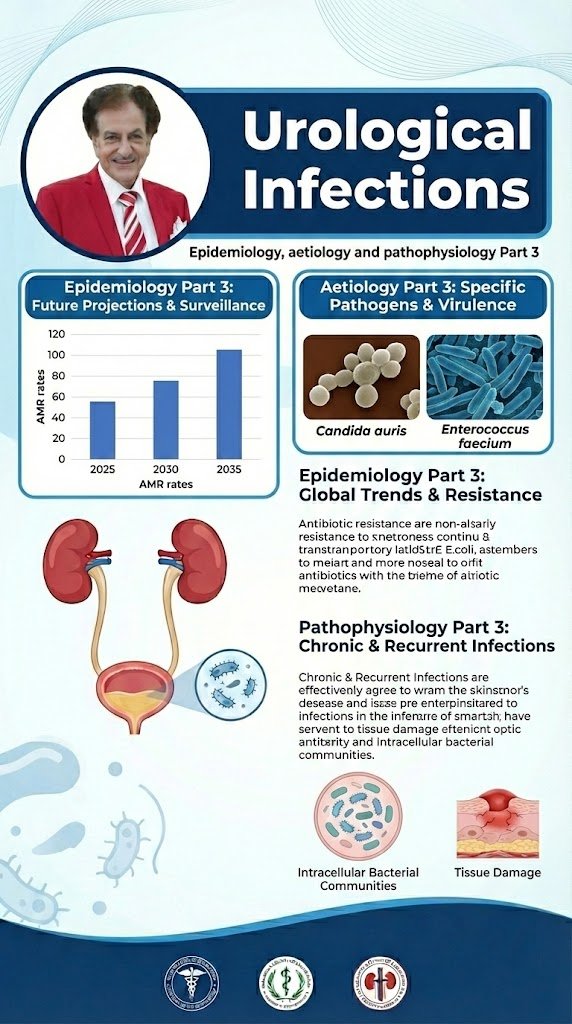

Urological Infections Epidemiology, aetiology and pathophysiology Part 1
Urological Infections Epidemiology, aetiology and pathophysiology Part 1 Comprehensive Review Article Prof. Dr. Semir. A. Salim. Al Samarrai Classification: Different classification systems of UTI exist. Most widely used are those developed by the Centres for Disease Control and Prevention (CDC) [1], Infectious Diseases Society of America (IDSA) [2], European Society of Clinical Microbiology and Infectious Diseases (ESCMID) [3] as well as the U.S. Food and Drug Administration (FDA) [4,5]. Current UTI guidelines frequently use the concept of uncomplicated and complicated UTI with a number of modifications (Figure 1). Figure 1: Concept of uncomplicated and complicated UTI The following classification of UTIs is adopted in the EAU Urological Infections Guidelines: Antimicrobial Stewardship Although the benefits to patients of antibiotic use are clear, overuse and misuse have contributed to the growing problem of resistance amongst uropathogenic bacteria, which is a serious threat to public health [6,7]. In acute care hospitals, 20-50% of prescribed antibiotics are either unnecessary or inappropriate [8]. In response, a worldwide initiative seeks to incorporate Antimicrobial Stewardship programs in healthcare [9]. Antimicrobial Stewardship aims to optimise clinical outcomes and ensure cost-effective therapy whilst minimising unintended consequences of antimicrobial use such as healthcare associated infections including Clostridium difficile, toxicity, selection of virulent organisms and emergence of resistant bacterial strains [10]. Asymptomatic bacteriuria in adults: Background Urinary growth of bacteria in an asymptomatic individual (asymptomatic bacteriuria – ABU) is common, and corresponds to a commensal colonisation [11]. Clinical studies have shown that ABU may protect against superinfecting symptomatic UTI, thus treatment of ABU should be performed only in cases of proven benefit for the patient to avoid the risk of selecting antimicrobial resistance and eradicating a potentially protective ABU strain [12,13]. Epidemiology, aetiology and pathophysiology Asymptomatic bacteriuria occurs in an estimated 1-5% of healthy pre-menopausal females. Increasing to 4-19% in otherwise healthy elderly females and men, 0.7-27% in patients with diabetes, 2-10% in pregnant women, 15-50% in institutionalised elderly populations, and in 23-89% in patients with spinal cord injuries [14]. Asymptomatic bacteriuria in younger men is uncommon, but when detected, chronic bacterial prostatitis must be considered. The spectrum of bacteria in ABU is similar to species found in uncomplicated or complicated UTIs, depending on the presence of risk factors. Diagnostic evaluation Asymptomatic bacteriuria in an individual without urinary tract symptoms is defined by a mid-stream sample of urine showing bacterial growth > 105 cfu/mL in two consecutive samples in women [15] and in one single sample in men [16]. In a single catheterised sample, bacterial growth may be as low as 102 cfu/mL to be considered representing true bacteriuria in both men and women [14,17]. Cystoscopy and/or imaging of the upper urinary tract is not mandatory if the medical history is otherwise without remark. If persistent growth of urease producing bacteria, i.e. Proteus mirabilis is detected, stone formation in the urinary tract must be excluded [18]. In men, a digital rectal examination (DRE) has to be performed to investigate the possibility of prostate diseases. Disease management: Patients without identified risk factors Asymptomatic bacteriuria does not cause renal disease or damage [19]. Only one prospective, non-randomised study investigated the effect of treatment of ABU in adult, non-diabetic, non-pregnant women [20], and found no difference in the rate of symptomatic UTIs. Furthermore, as the treatment of ABU has been proven to be unnecessary in most high-risk patient subgroups, there is panel consensus that the results of these subgroups can also be applied to patients without identified risk factors. Therefore, screening and treatment of ABU is not recommended in patients without risk factors. Patients with ABU and recurrent UTI, otherwise healthy One RCT investigated the effect of asymptomatic bacteriuria (ABU) treatment in female patients with recurrent symptomatic UTI without identified risk factors [13] and demonstrated that treatment of ABU increases the risk for a subsequent symptomatic UTI episode, compared to non-treated patients (RR 0.28, 95% CI 0.21 to 0.38; n=673). This protective effect of spontaneously developed ABU can be used as part of prevention in female patients with recurrent symptomatic UTI; therefore, treatment of ABU is not recommended. Pregnant women: Is treatment of ABU beneficial in pregnant women? Twelve RCTs comparing antibiotic treatments of ABU with placebo controls or no treatment [21-32], with different antibiotic doses and regimens were identified, ten published before 1988 and one in 2015. Eleven RCTs (n=2,002) reported on the rate of symptomatic UTIs [21,23-31,33]. Antibiotic treatment significantly reduced the number of symptomatic UTIs compared to placebo or no treatment (average RR 0.22, 95% CI 0.12 to 0.40). Six RCTs reported on the resolution of bacteriuria [21-23,25,28,30]. Antibiotic treatment was effective in the resolution of bacteriuria compared to placebo (average RR 2.99, 95% CI 1.65 to 5.39; n=716). Eight RCTs reported on the rate of low birthweights [21,23-26,29,32,33]. Antibiotic treatment was associated with lower rates of low birthweight compared to placebo or no treatment (average RR 0.58, 95% CI 0.36 to 0.94; n=1,689). Four RCTs reported on the rate of preterm deliveries [29,30,32,33]. Antibiotic treatment was associated with lower rates of preterm delivery compared to placebo or no treatment (average RR 0.34, 95% CI 0.18 to 0.66; n=854). Based on the beneficial maternal and foetal effects of antibiotic treatment pregnant women should be screened and treated for ABU. However, the panel of EAU Guidelines edition 2022 would like to emphasize that most available studies have low methodological quality and are from the 60s to 80s. Diagnostic and treatment protocols and accessibility to medical services have dramatically changed since then; therefore, the quality of evidence for this recommendation is low. In a newer study of higher methodological quality, the beneficial effects of antibiotic treatment are not as evident [33]. Therefore, it is advisable to consult national recommendations for pregnant women. Which treatment duration should be applied to treat ABU in pregnancy? Sixteen RCTs comparing the efficacy of different antibiotic treatments in pregnant women with ABU were identified [34-49]. There was significant heterogeneity amongst the studies. Studies compared
Urological Infections Epidemiology, aetiology and pathophysiology Part 1 قراءة المزيد »