
Overactive Urinary Bladder

Overactive Urinary Bladder

Overactive Urinary Bladder

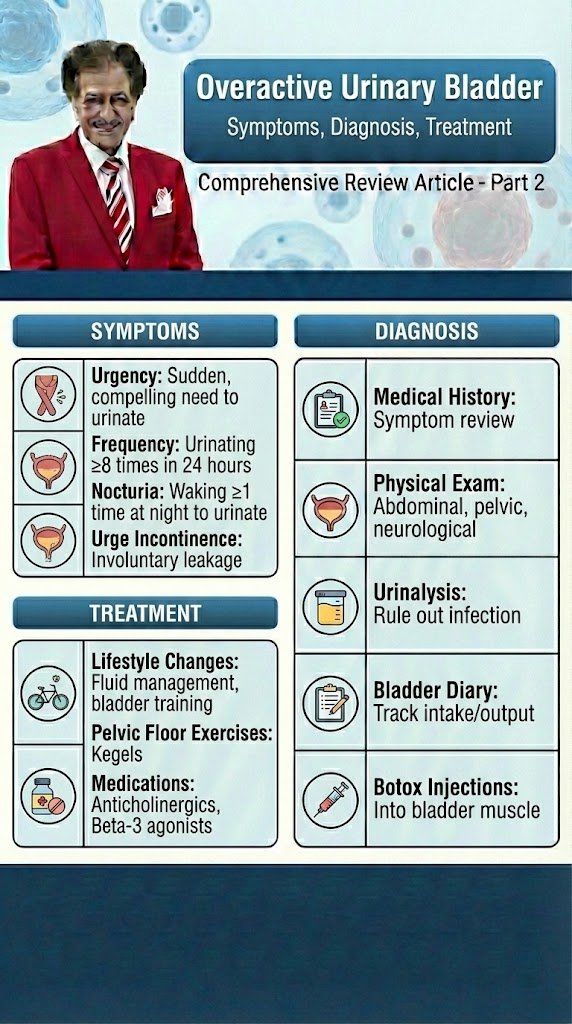
Overactive Urinary Bladder Diagnostic and Evaluation Comprehensive Review Article Part 2 Prof. Dr. Semir. A. Salim. Al Samarrai Taking a thorough clinical history is fundamental to the process of clinical evaluation. Despite the lack of high-level evidence to support taking a history, there is universal agreement that it should be the first step in the assessment of anyone with lower urinary tract symptoms (LUTS). The history should include a full evaluation of LUTS, as well as sexual, gastrointestinal and neurological symptoms. Details of urgency episodes, the type, timing and severity of urinary incontinence (UI), and some attempt to quantify symptoms should also be made. The history should help to categorise LUTS as storage, voiding and post-micturition symptoms, and classify UI as stress urinary incontinence (SUI), urge urinary incontinence (UUI), mixed urinary incontinence (MUI) or overflow incontinence; the latter being defined as “the complaint of UI in the symptomatic presence of an excessively (over-) full bladder (no cause identified)” [1]. The history should also identify patients who need referral to an appropriate clinic/specialist. These may include patients with associated pain, haematuria, history of recurrent urinary tract infection (UTI), pelvic surgery or radiotherapy, constant leakage suggesting a fistula, new-onset enuresis or suspected neurological disease. A neurological, obstetric and gynaecological history may help to understand the underlying cause and identify factors that may affect treatment decisions. Guidance on history-taking and diagnosis in relation to UTIs, neuro-urological conditions and chronic pelvic pain (CPP) can be found in the relevant EAU Guidelines [2,3,4]. Patients should also be asked about other comorbidity as well as smoking status, previous surgical procedures and current medications, as these may affect LUTS. There is little evidence from clinical trials that carrying out a clinical examination improves outcomes, but widespread consensus suggests that clinical examination remains an essential part of assessment of patients with LUTS. Examination should include abdominal examination, to detect an enlarged urinary bladder or other abdominal mass, and digital examination of the vagina and/or rectum. Pelvic examination in women includes assessment of oestrogen status, pelvic floor muscle (PFM) function and careful assessment of any associated pelvic organ prolapse (POP). A cough stress test is necessary to look for stress urinary incontinence (SUI). Among women with genital prolapse, the cough test was found to show good agreement with urodynamic studies (UDS) in the detection of SUI. Urethral mobility can be assessed. Pelvic floor muscle contraction strength can also be assessed digitally. A focused neuro-urological examination should also be routinely undertaken. Patient questionnaires include symptom scores, symptom questionnaires/scales/indices, patient-reported outcome measures (PROMs) and health-related quality of life (QoL) measures. Questionnaires should have been validated for the language in which they are being used, and, if used for outcome evaluation, should have been shown to be sensitive to change. The US Food and Drug Administration (FDA) published guidance for industry on PROM instruments (questionnaires) in 2009 [5]. Patient bladder diaries include measurement of the frequency and severity of LUTS and is an important step in the evaluation and management of LUT dysfunction. Bladder diaries are a semi-objective method of quantifying symptoms, such as frequency of urinary incontinence (UI) events, number of nocturia episodes, etc. Fluid intake and voided volume measurement can be used to support diagnoses and management planning, for example in overactive bladder (OAB), and for identifying 24-hour or nocturnal polyuria. The optimum number of days required for bladder diaries appears to be based on a balance between accuracy and compliance [6,7]. Diary durations between three and seven days are routinely reported in the literature. The urinalysis and urinary tract infection investigations are a very important steps in the evaluation and therapy of UTI. Reagent strip (dipstick) urinalysis may indicate proteinuria, haematuria or glycosuria, or suggest UTI requiring further assessment. Urine dipstick testing is a useful adjunct to clinical evaluation in patients in whom urinary symptoms are suspected to be due to UTI. Urinalysis negative for nitrite and leukocyte esterase may exclude bacteriuria in women with LUTS [8], and should be included, with urine culture when necessary, in the evaluation of all patients with LUTS. Urinary incontinence or worsening of LUTS may occur during UTI [9] and existing UI may worsen [10]. The rate and severity of UI were unchanged after eradication of asymptomatic bacteriuria in nursing home residents [11]. The post-void residual volume measurement is also important step in the evaluation and management of OAB and obstruction LUT-Disorders. Post-void residual (PVR) volume is the amount of urine that remains in the bladder after voiding. It is a measure of voiding efficiency, and results from a number of contributing factors. The detection of significant PVR volume is important because it may worsen symptoms and, more rarely, may be associated with UTI, upper urinary tract (UUT) dilatation and renal insufficiency. Both BOO and/or detrusor underactivity (DU) can potentially contribute to the development of significant PVR volume. Post-void residual volume can be measured by catheterisation or ultrasound (US). Most studies investigating PVR volume have assessed mixed populations including those with neurogenic UI. In general, the data on PVR volume can be applied with caution to women with non-neurogenic LUTS. The results of studies investigating the best method of measuring PVR volume [11-16] have led to the consensus that US measurement of PVR volume is preferable to catheterisation due to its favourable risk–benefit profile. In peri- and postmenopausal women without significant LUTS or pelvic organ symptoms, 95% had a PVR volume < 100 mL [17]. In women with UUI, PVR volume > 100 mL was found in only 10% of cases [18]. Other research has found that a high PVR volume is associated with pelvic organ prolapse (POP), voiding symptoms and an absence of SUI [17, 19–21]. In women with SUI, the mean PVR volume was 39 mL measured by catheterisation and 63 mL measured by US, with 16% of women having PVR volume > 100 mL [22]. Some authors have suggested that it is reasonable to consider a PVR volume > 100 mL to be significant, although many women may remain

Overactive Urinary Bladder قراءة المزيد »

Overactive Urinary Bladder

Overactive Urinary Bladder

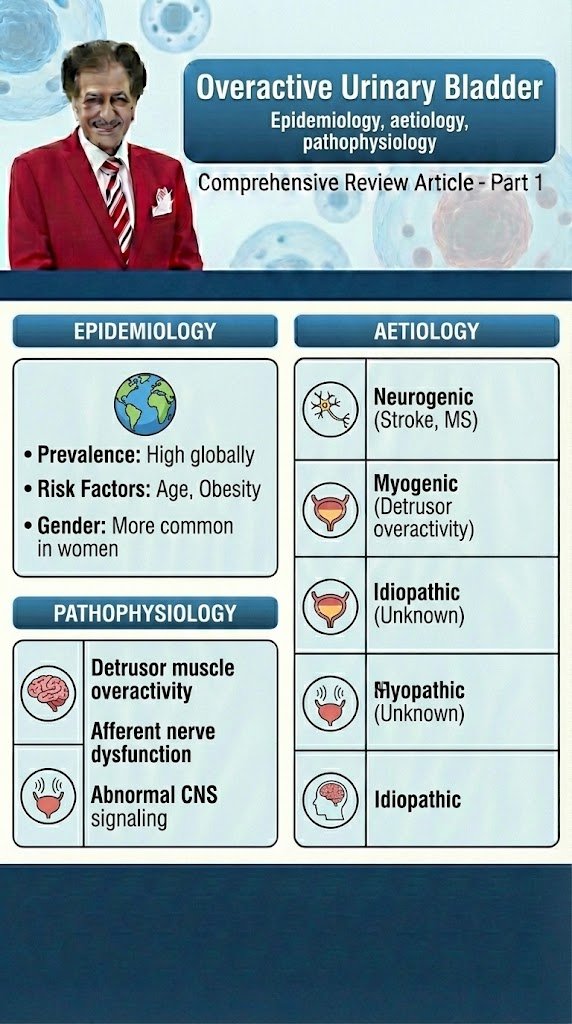
Overactive Urinary Bladder Epidemiology, aetiology, pathophysiology Comprehensive Review Article Part 1 Prof. Dr. Semir. A. Salim. Al Samarrai Overactive bladder is defined by the International Continence Society (ICS) as “urinary urgency, usually accompanied by frequency and nocturia, with or without (Urge Urinary Incontinence (UUI), in the absence of Urinary Tract Infection (UTI) or other obvious pathology” [1]. Overactive bladder is a chronic condition and can have debilitating effects on QoL. The hallmark urodynamic feature is Detrusor Overactivity (DO), although this may not be demonstrated in a large proportion of Overactive Bladder (OAB) patients, which may partly be due to failure to reproduce symptoms during urodynamic assessment. The EPidemiology of InContinence (EPIC) study was one of the largest population-based surveys of the prevalence of LUTS and OAB [2]. It was a cross-sectional telephone survey of adults aged > 18 years conducted in five countries, including Canada, Germany, Italy, Sweden and the UK. The study included > 19,000 participants and demonstrated an overall prevalence of OAB symptoms of 11.8% (10.8% in men and 12.8% in women). Other studies have reported prevalences of up to 30 to 40%, with rates generally increasing with age [3]. Various theories have been proposed to explain the pathophysiology of OAB, mainly relating to imbalances in inhibitory and excitatory neural pathways to the bladder and the urethra or sensitivity of bladder muscle receptors. However, no definite identifiable causes have been established. Overactive bladder is generally classified into wet and dry, based on the presence or absence of associated Urinary Incontinence (UI). Evaluation of symptoms of OAB follows the general pathway of evaluation of women with LUTS. The Diaries are particularly helpful in establishing and quantifying symptoms of frequency, urgency and UI, and may be valuable in assessing change over time or response to treatment. Several observational studies have demonstrated a close correlation between data obtained from bladder diaries and standard symptom evaluation [4–7]. The optimum number of days required for bladder diaries appears to be based on a balance between accuracy and compliance. Diary duration of three to seven days is routinely used in the literature. The Urodynamics is essential in establishing the presence of DO, but its absence does not preclude diagnosis of OAB, which is based on symptoms alone. A Cochrane review of seven RCTs showed that use of urodynamic tests increased the likelihood of prescribing drugs or avoiding surgery. However, there was no evidence that this influence on decision-making altered the clinical outcome of treatment [8]. A sub-analysis of an RCT comparing fesoterodine to placebo [9] showed that the urodynamic diagnosis of DO had no predictive value for treatment response. A single report (SR) and meta-analysis indicated that the urinary tract nerve growth factor (Urinary NGF) and Brain-divided neurotrophic factor or abneurin are members of the neurotrophic family of growth factors were increased in female OAB patients as urinary biomarker compared to healthy controls, whereas no difference was found for the prostaglandins E2 (PGE2) level normalized to the concentration of the urinary creatine was elevated and higher in the BPH/OAB than in the BPH/non-groups [10]. The current data is inadequate to assess any other potential biomarkers, such as urinary malondialdehyde (UMDA), ATP, and cytokines, in the management of OAB in female patients. Further studies are needed to establish their potential as diagnostic and management tools in OAB women. The conservative management of the overactive bladder has long been recommended as first in clinical practice, because they usually carry the lowest risk of harm. While this remains true for non-pharmacological conservative treatments [e.g., pelvic floor muscle training (PFMT)], increasing concerns regarding the adverse events of some pharmacological treatments used to treat LUTS (e.g., anticholinergic drugs), particularly regarding cognitive function, have emerged and patients should be fully counselled regarding this potential risk. It is possible that improvement of associated disease may reduce the severity of the lower urinary tract symptoms (LUTS), especially in elderly patients, which are associated with multiple comorbid conditions including: • cardiac failure; • chronic renal failure; • diabetes; • chronic obstructive pulmonary disease; • neurological disease; • general cognitive impairment; • sleep disturbances, e.g., sleep apnoea; • depression; • metabolic syndrome. The Lifestyle factors that may be associated with UI include obesity, smoking, level of physical activity, regulation of bowel habit and fluid intake. Modification of these factors may improve symptoms of OAB. The caffeine intake in many drinks contain caffeine are particularly coffee, tea and cola. Conflicting epidemiological evidence of urinary symptoms being aggravated by caffeine intake has focused on whether caffeine reduction improves LUTS [11, 12]. A scoping review of fourteen interventional and twelve observational studies reported that reduction in caffeine intake may reduce symptoms of urgency, but the certainty of evidence was low, with significant heterogeneity in study populations [13]. The fluid intake modification are particularly restriction, and is a strategy commonly used by people with OAB to relieve symptoms. Any advice on fluid intake given by HCPs should be based on 24-hour fluid intake and urine output measurements as retrieved from the bladder diary. From a general health point of view, it should be advised that fluid intake should be sufficient to avoid thirst and that an abnormally low or high 24-hour urine output should be investigated. The few RCTs that have been published provide inconsistent evidence [14-16]. In most studies, the instructions for fluid intake were individualised and it was difficult to assess participant adherence. All available studies were in women. An RCT showed that a reduction in fluid intake by 25% improved symptoms in patients with OAB but not UI [16]. Personalised fluid advice compared to generic advice made no difference to continence outcomes in people receiving anticholinergics for OAB, according to an RCT comparing drug therapy alone to drug therapy with behavioural advice [17]. Patients should be warned of the potential consequences of fluid restriction such as worsening of constipation or development of UTI. The obesity and overweight have been identified as a risk factors for LUTS in many epidemiological studies [18, 19]. There is

Overactive Urinary Bladder قراءة المزيد »

Overactive Urinary Bladder

Overactive Urinary Bladder Epidemiology, aetiology, pathophysiology Narrative Review Article Part 1 Prof. Dr. Semir. A. Salim. Al Samarrai Overactive bladder is defined by the International Continence Society (ICS) as “urinary urgency, usually accompanied by frequency and nocturia, with or without (Urge Urinary Incontinence (UUI), in the absence of Urinary Tract Infection (UTI) or other obvious pathology” [1]. Overactive bladder is a chronic condition and can have debilitating effects on QoL. The hallmark urodynamic feature is Detrusor Overactivity (DO), although this may not be demonstrated in a large proportion of Overactive Bladder (OAB) patients, which may partly be due to failure to reproduce symptoms during urodynamic assessment. The EPidemiology of InContinence (EPIC) study was one of the largest population-based surveys of the prevalence of LUTS and OAB [2]. It was a cross-sectional telephone survey of adults aged > 18 years conducted in five countries, including Canada, Germany, Italy, Sweden and the UK. The study included > 19,000 participants and demonstrated an overall prevalence of OAB symptoms of 11.8% (10.8% in men and 12.8% in women). Other studies have reported prevalences of up to 30 to 40%, with rates generally increasing with age [3]. Various theories have been proposed to explain the pathophysiology of OAB, mainly relating to imbalances in inhibitory and excitatory neural pathways to the bladder and the urethra or sensitivity of bladder muscle receptors. However, no definite identifiable causes have been established. Overactive bladder is generally classified into wet and dry, based on the presence or absence of associated Urinary Incontinence (UI). Evaluation of symptoms of OAB follows the general pathway of evaluation of women with LUTS. The Diaries are particularly helpful in establishing and quantifying symptoms of frequency, urgency and UI, and may be valuable in assessing change over time or response to treatment. Several observational studies have demonstrated a close correlation between data obtained from bladder diaries and standard symptom evaluation [4-7]. The optimum number of days required for bladder diaries appears to be based on a balance between accuracy and compliance. Diary duration of three to seven days is routinely used in the literature. The Urodynamics is essential in establishing the presence of DO, but its absence does not preclude diagnosis of OAB, which is based on symptoms alone. A Cochrane review of seven RCTs showed that use of urodynamic tests increased the likelihood of prescribing drugs or avoiding surgery. However, there was no evidence that this influence on decision-making altered the clinical outcome of treatment [8]. A sub-analysis of an RCT comparing fesoterodine to placebo [9] showed that the urodynamic diagnosis of DO had no predictive value for treatment response. A single report (SR) and meta-analysis indicated that the urinary tract nerve growth factor (Urinary NGF) and Brain-divided neurotrophic factor or abneurin are members of the neurotrophic family of growth factors were increased in female OAB patients as urinary biomarker compared to healthy controls, whereas no difference was found for the prostaglandins E2 (PGE2) level normalized to the concentration of the urinary creatine was elevated and higher in the BPH/OAB than in the BPH/non-groups [10]. The current data is inadequate to assess any other potential biomarkers, such as urinary malondialdehyde (UMDA), ATP, and cytokines, in the management of OAB in female patients. Further studies are needed to establish their potential as diagnostic and management tools in OAB women. The conservative management of the overactive bladder has long been recommended as first in clinical practice, because they usually carry the lowest risk of harm. While this remains true for non-pharmacological conservative treatments [e.g., pelvic floor muscle training (PFMT)], increasing concerns regarding the adverse events of some pharmacological treatments used to treat LUTS (e.g., anticholinergic drugs), particularly regarding cognitive function, have emerged and patients should be fully counselled regarding this potential risk. It is possible that improvement of associated disease may reduce the severity of the lower urinary tract symptoms (LUTS), especially in elderly patients, which are associated with multiple comorbid conditions including: • cardiac failure; • chronic renal failure; • diabetes; • chronic obstructive pulmonary disease; • neurological disease; • general cognitive impairment; • sleep disturbances, e.g., sleep apnoea; • depression; • metabolic syndrome. The Lifestyle factors that may be associated with UI include obesity, smoking, level of physical activity, regulation of bowel habit and fluid intake. Modification of these factors may improve symptoms of OAB. The caffeine intake in many drinks contain caffeine are particularly coffee, tea and cola. Conflicting epidemiological evidence of urinary symptoms being aggravated by caffeine intake has focused on whether caffeine reduction improves LUTS [11, 12]. A scoping review of fourteen interventional and twelve observational studies reported that reduction in caffeine intake may reduce symptoms of urgency, but the certainty of evidence was low, with significant heterogeneity in study populations [13]. The fluid intake modification are particularly restriction, and is a strategy commonly used by people with OAB to relieve symptoms. Any advice on fluid intake given by HCPs should be based on 24-hour fluid intake and urine output measurements as retrieved from the bladder diary. From a general health point of view, it should be advised that fluid intake should be sufficient to avoid thirst and that an abnormally low or high 24-hour urine output should be investigated. The few RCTs that have been published provide inconsistent evidence [14-16]. In most studies, the instructions for fluid intake were individualised and it was difficult to assess participant adherence. All available studies were in women. An RCT showed that a reduction in fluid intake by 25% improved symptoms in patients with OAB but not UI [16]. Personalised fluid advice compared to generic advice made no difference to continence outcomes in people receiving anticholinergics for OAB, according to an RCT comparing drug therapy alone to drug therapy with behavioural advice [17]. Patients should be warned of the potential consequences of fluid restriction such as worsening of constipation or development of UTI. The obesity and overweight have been identified as a risk factors for LUTS in many epidemiological studies [18, 19]. There is

Overactive Urinary Bladder قراءة المزيد »

Scroll to Top